
Why Every Local Business Needs a Website (Not Just a Google Listing)
A Google Business Profile and social media page aren't enough. Here's why a proper website is the missing foundation for local SEO, trust, and customer conversions.
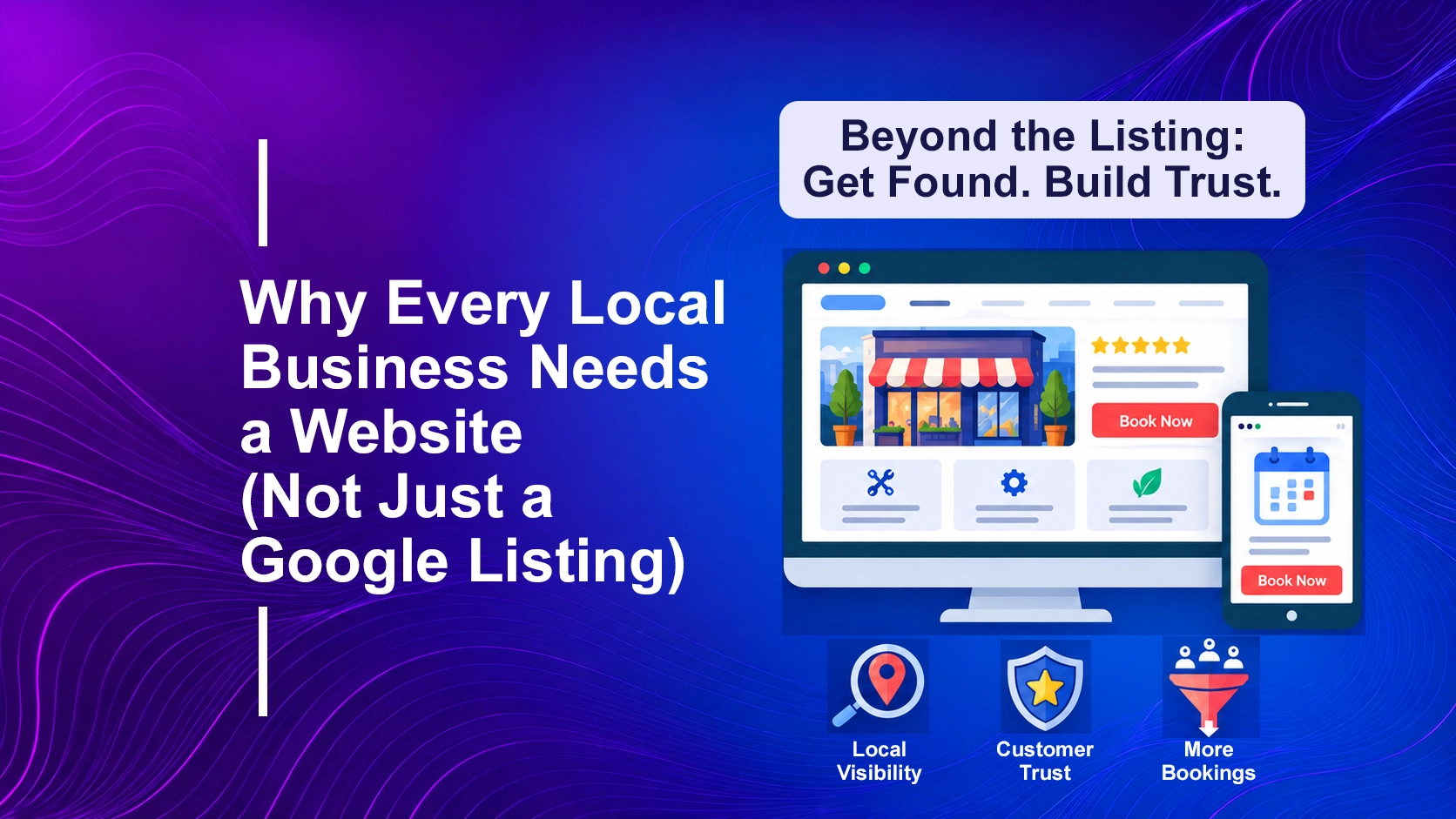
Why Every Local Business Needs a Website (Not Just a Google Listing)
A lot of local business owners still believe a Google Business Profile and an Instagram page are enough. They're not. Here's why a proper website isn't optional anymore, no matter which city or country you're operating in.
Local Search Is Competitive Everywhere
Whether you're running a clinic in Austin, a salon in London, or a consulting firm in Delhi NCR, the pattern is the same. Dense clusters of businesses are fighting for the same customers within a few kilometers of each other.
When someone searches "best dentist near me" or "interior designer in [city]," here's what happens:
- Google ranks results based on proximity, relevance, and website authority.
- Businesses without a website often don't show up at all, or show up with a thin, unverified listing.
- Competitors with an actual website—even a basic one optimized for local SEO—consistently outrank those without one.
This holds true in nearly every major market we've looked at, from North American suburbs to dense regional hubs like Delhi NCR, where several cities sit close enough together that local search behavior spans across all of them. If your business isn't searchable with real content behind it, you're invisible to a huge chunk of local demand before a customer ever picks up the phone.
A Google Listing Alone Doesn't Build Trust
A listing gives someone your address and a star rating. That's it. It doesn't answer the real questions a potential customer has:
- What exactly do you offer, and at what price range?
- Do you have real reviews, case studies, or work samples?
- Is this business still active and reliable?
- Why should I choose you over the other options nearby?
A website answers all of that in one place. For local businesses anywhere, especially where buyers compare multiple vendors before committing, that trust layer is often the deciding factor.
Local SEO Only Works With a Website Behind It
This is the part most business owners miss. Local SEO isn't just a Google Business Profile. It's a connected ecosystem, and a website is the foundation of that system:
- On-page local signals. Pages that mention your service area—whether that's a single neighborhood or a wider region—tell Google exactly where and what you serve. This matters just as much for a business targeting one suburb as it does for one targeting a sprawling metro area like Delhi NCR.
- Technical SEO basics. Fast load times, mobile optimization, and clean site structure directly affect how well you rank, especially on mobile, where the vast majority of local searches happen.
- Content that targets long-tail local searches. Someone searching "affordable orthodontist in [specific neighborhood]" is a much warmer lead than someone searching "orthodontist." A website lets you build pages that catch these specific searches. A listing alone can't.
- Backlink and citation value. Other local directories, press mentions, and partner sites link back to your website, not your Instagram page. Every one of those links adds to your local authority over time.
Without a website, you're trying to run local SEO with half the pieces missing, regardless of where in the world your customers are searching from.
A Website Is Also Your Conversion Engine
Visibility gets someone to find you. The website is what turns that visit into an actual customer. This is where a lot of local businesses lose people they already attracted:
- No clear call to action (call now, book appointment, get a quote)
- No landing page system to route different types of visitors to the right next step
- Slow, cluttered pages that make people leave before they even see what you offer
A website built for conversion, not just appearance, makes sure that traffic from Google actually turns into calls, bookings, or store visits. This is the gap between businesses that get found and businesses that get found and chosen.
Target Your City, But Think Regionally Too
A lot of local businesses only optimize for their exact locality, like "salon in Brooklyn" or "gym downtown." That's correct, but incomplete.
Here's why layering in a broader regional keyword matters, no matter where you're based:
- People move across nearby areas constantly for work, shopping, and services. Someone living in one part of a metro region regularly searches for options in a neighboring one. This is especially true in large, multi-city regions like Delhi NCR, the Bay Area, or Greater London, but it applies on a smaller scale almost everywhere.
- Search volume is higher for broader regional terms. This means more total opportunity if your website is structured to rank for it alongside your specific locality.
- It signals scale and credibility. A business that shows up for both hyperlocal and regional searches looks more established than one that only shows up for a single neighborhood.
The right approach is layering both: hyperlocal pages for your exact area, plus broader content and metadata targeting the wider region you actually serve. A website with proper technical SEO and a clear page structure can target both at once. A Google listing alone cannot.
What This Means If You Don't Have a Website Yet
If your business is still running on just a listing and social media, here's the practical risk:
- You're losing local search traffic to competitors who do have a website
- You're harder to trust for anyone comparing options before they commit
- You have no way to capture or convert the traffic that is finding you
- You're invisible for a large share of regional searches, not just searches in your immediate neighborhood
None of this requires a massive, expensive build to start. It requires a website that's structured correctly from day one, built with local and regional SEO in mind, and designed to actually convert the traffic it earns.
Where to Start
If you're a local business without a website, or with one that isn't pulling its weight, the first step isn't a redesign. It's understanding exactly where you're losing visibility and conversions right now, wherever in the world you're based.
We offer a free AEO audit that looks at your current online presence (or lack of one) and shows you exactly where the gaps are, with no obligation attached.
Book a Free AEO Audit and find out what local searches you're missing right now.
FAQ
Why isn't a Google Business Profile enough for a local business?
A Google listing displays basic details like your address and reviews, but it doesn't give you ranking authority for competitive long-tail search terms, nor does it provide a tailored conversion platform where prospective clients can review comprehensive case studies, service breakdowns, and clear paths to purchase.
How does a website improve local SEO rankings?
A website provides search engines with localized schema markup, dedicated service-area pages, and core technical signals (like load speed and mobile responsiveness). It also provides a primary destination for citations and quality backlinks that significantly boost domain authority.
Should I optimize for my exact neighborhood or my whole metro region?
Both. The strongest local SEO strategy layers hyperlocal landing pages targeting your specific neighborhood with broader regional content that captures high-volume searches from people commuting or shopping across the wider metropolitan area.
Can a local business rank without an expensive custom website?
Yes. What matters most is site structure, speed, localized content, and mobile usability. Even a lean, well-structured website will consistently outperform competitors who rely solely on social media or unoptimized map listings.