
How to Know If Your Marketing Is Actually Working
Not sure if your marketing is paying off? Learn the signs, the metrics that matter, and a simple 30-day plan to find out what's really working.
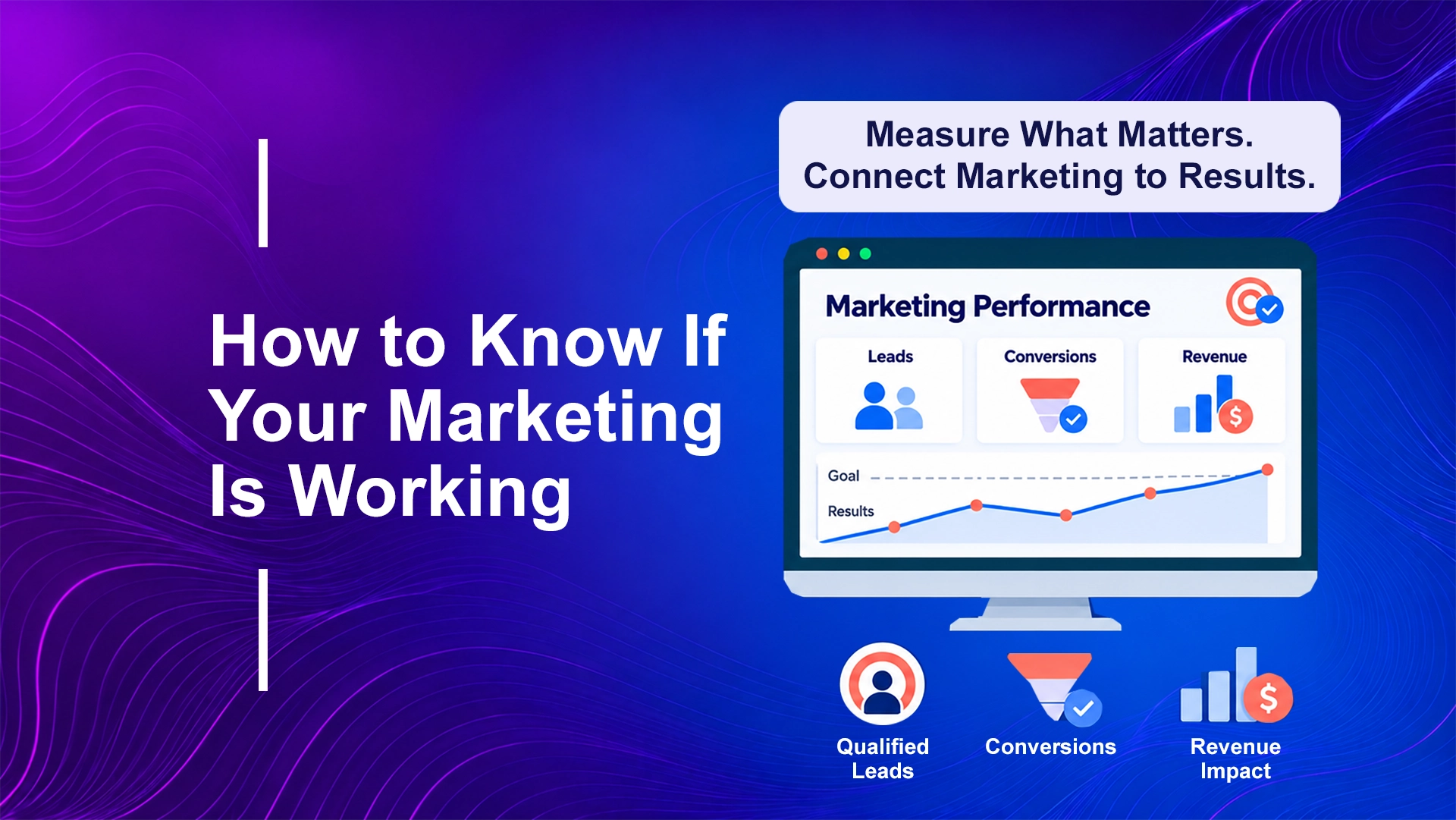
How to Know If Your Marketing Is Actually Working
Let's start with a quiet confession most businesses won't say out loud.
You're doing a lot of marketing. Posts go out. Emails get sent. Ads are running. Somebody is working on SEO. There's a report every month, and it's full of charts.
And yet, if someone asked you point-blank, "Is it actually working?", you'd hesitate.
That hesitation is the problem this guide solves. By the end, you'll have a clear, reliable way to answer that question with evidence instead of a gut feeling. No fancy enterprise tools needed. No 50-metric dashboard. Just the right questions, in the right order.
Why It's So Hard to Tell If Marketing Is Working
Marketing produces a huge amount of data—and almost none of it gives you the real answer.
Impressions, reach, followers, likes, open rates, page views, clicks. Every platform has its own numbers, its own dashboard, and its own self-serving definition of what "success" looks like. Each one tells a small piece of the story, but none tells you whether the business actually grew because of it.
Three things make this clarity even harder to achieve:
- Results are delayed. A person might read your blog today, follow your company next month, and submit an enquiry in three months. By the time they convert, nobody remembers what spark ignited the journey.
- Credit is messy. Did the sale come from a paid ad, an automated email, an organic Google search, or a recommendation from a friend? In reality, it's usually a combination of all of them working together.
- Activity feels like progress. Being busy is comforting. A full content calendar looks and feels like a marketing strategy, even when it isn't driving revenue.
The way out is simple: stop asking "How much are we doing?" and start asking "What is it doing for us?"
Busy Marketing vs. Working Marketing
These two get confused all the time, so let's clearly separate them:
- Busy marketing is measured in effort: posts published, emails sent, ad campaigns launched, and agency hours billed.
- Working marketing is measured in outcomes: qualified enquiries received, customers won, revenue earned, and long-term customer retention.
You can have a mountain of effort and zero outcomes. Conversely, you can have a lean, focused marketing engine that quietly pays for itself many times over.
The goal of this guide is to help you determine which one you have.
Step 1: Decide What "Working" Means for You
Here's the step almost everyone skips. Before you look at a single dashboard number, write down what marketing is supposed to achieve right now.
Pick one primary goal:
- Generate more qualified leads (typical for B2B and high-touch service businesses)
- Increase sales or bookings (typical for e-commerce and local businesses)
- Bring back past customers (typical for subscription or repeat-purchase businesses)
- Build targeted awareness in an entirely new market or vertical
Why only one goal? Because "grow everything" cannot be measured effectively. A single goal gives you a single benchmark: "Is this initiative helping us achieve that goal?" Every metric you track from here must directly support it. If a number doesn't connect to that goal, it's just decoration.
Step 2: Follow the Customer Journey, Stage by Stage
Marketing operates like a funnel. Different stages require completely different measurements. Judging brand awareness by immediate sales—or judging conversion efficiency by follower counts—is how businesses end up confused.
1. Awareness: Are the Right People Finding You?
This is the "does our target market know we exist?" stage.
- What to look at:
- Organic search traffic (high-intent searches on Google)
- Branded searches (people actively searching for your company name)
- Direct website visits
- Reach among your ideal client profile, not a generic audience
- A good sign: Traffic from relevant, qualified searches grows steadily, and more prospects search for your brand name directly.
- A warning sign: Massive spikes in traffic from people who would never buy from you. A viral post that attracts an irrelevant crowd is just noise.
2. Consideration: Are They Engaging, or Bouncing?
Now that visitors have arrived on your site, do they care about what you do?
- What to look at:
- Average time spent on key service pages
- Number of pages viewed per visit
- Scroll depth on core content and case studies
- Returning visitor rates
- Email sign-ups and resource downloads
- A good sign: Visitors actively read your service breakdowns, review your case studies, and return multiple times.
- A warning sign: Visitors land and bounce within seconds. That almost always points to a mismatch between search intent and page content, or a page that is slow, cluttered, or difficult to navigate. This is where thoughtful UI/UX and web design completely transforms performance.
3. Conversion: Are They Taking Action?
This is the stage that decides whether your marketing investment earns its keep.
- What to look at:
- Conversion rate (the percentage of visitors who enquire, book, or buy)
- Cost per lead (CPL)
- Lead quality and sales-readiness
- Form completion and booking flow rates
- A good sign: A consistent stream of qualified enquiries that your sales team is excited to speak with.
- A warning sign: Plenty of incoming form submissions, but the vast majority are spam, low-budget, or outside your service scope. That is a targeting or positioning problem, not a lead volume problem.
4. Retention: Do They Stay and Come Back?
Winning a customer is only half the battle; keeping them is where true profitability happens.
- What to look at:
- Repeat purchase, renewal, or contract extension rates
- Customer lifetime value (LTV)
- Client referrals and organic word of mouth
- Engagement rates among existing clients
- A good sign: Existing clients stay longer, expand their retainers, and refer new business.
- A warning sign: You have to constantly replace churned clients just to keep revenue flat. That is the most expensive and exhausting way to run a business.
The Metrics That Matter (and the Ones That Don't)
You don't need a bloated 50-metric dashboard. You only need a disciplined set of core metrics:
- Conversion Rate: The percentage of visitors who take your desired action. It proves whether your messaging, website UX, and offer actually work.
- Cost per Lead (CPL): What it costs in media and effort to generate one enquiry. It reveals channel-by-channel efficiency.
- Customer Acquisition Cost (CAC): The total blended cost to acquire one paying customer. It reveals the true economic cost of growth.
- Lead Quality: The percentage of enquiries that match your Ideal Customer Profile. It separates vanity volume from commercial value.
- Return on Ad Spend (ROAS): Revenue generated per dollar spent on paid campaigns. It indicates whether advertising is profitable.
- Customer Lifetime Value (LTV): The total gross margin or revenue an average client generates over their relationship with you.
- Organic Search Visibility: How consistently you rank for high-intent search queries. It represents long-term compounding growth.
The Golden Ratio: LTV to CAC
$$\text{Healthy Unit Economics} = \frac{\text{Customer Lifetime Value (LTV)}}{\text{Customer Acquisition Cost (CAC)}} \ge 3:1$$
If a customer is worth significantly more than what it costs to acquire them, your marketing has room to scale aggressively. If your CAC approaches or exceeds your LTV, your funnel has leaks that must be fixed before you spend another dollar.
Vanity metrics to treat with caution: Follower counts, social likes, raw impression counts, and aggregate page views. They aren't inherently useless, but on their own they will never tell you whether your business is healthy or growing.
7 Signs Your Marketing Is Working
- The right people are enquiring: Not just more leads, but higher-quality conversations. When your sales team says, "These prospects actually understand our value," your marketing is doing its job.
- Traffic reliably turns into action: Qualified visitors don't just browse; they fill out forms, schedule calls, and download assets.
- People find you without being chased: You appear organically for commercial keywords, and prospective clients reach out proactively.
- Customers tell you how they found you: When you ask new clients, "How did you hear about us?", their unprompted answers validate your key channels.
- Your sales cycle is getting shorter: Prospects arrive pre-educated by your content, which means deals close faster with less friction.
- Repeat business and referrals are climbing: Sustainable marketing continues working long after the initial contract is signed.
- You can directly connect spend to pipeline revenue: Being able to state, "We invested this much in this channel, and it produced that much in closed revenue," is the ultimate sign of marketing maturity.
A Simple 30-Day Plan to Find Out What's Working
Week 1: Set the Foundation
- Define your single primary marketing goal for the quarter.
- Verify your analytics tracking. Submit a test form on your site and confirm it records as a conversion in Google Analytics and your CRM.
Week 2: Gather the Hard Data
- Pull your numbers for the last 90 days: traffic channels, total ad spend, leads generated, and new closed deals.
- Don't judge or alter anything yet. Just assemble the raw numbers.
Week 3: Talk to Real Humans
- Sit down with your sales team: which leads were great to talk to, and why?
- Contact 5 recent customers: ask how they first discovered you and what specific factor made them choose you over competitors.
Week 4: Make Ruthless Decisions
- Fill out your scorecard:
- Stop: One channel or activity that consumes budget/time without producing pipeline.
- Fix: One high-traffic page or offer that has a poor conversion rate.
- Double Down: The single channel that consistently delivers your highest-value clients.
- Set a recurring calendar reminder for your next quarterly review.
Common Mistakes to Avoid
- Judging too early: SEO, AEO, and content strategies require 3–6 months to compound. Don't abandon a sound strategy after 3 weeks.
- Judging too late: The opposite mistake: letting a clearly unprofitable paid campaign run for 12 months without accountability.
- Chasing every shiny new metric: More dashboards create noise, not clarity. Focus strictly on metrics tied to your primary goal.
- Ignoring the sales team: Sales reps interact with lead quality every single day. A marketing report that claims success while sales starves is failing.
- Changing everything all at once: If you overhaul your copy, ad creative, landing page layout, and pricing simultaneously, you'll never know which change worked.
- Relying solely on platform attribution: Ad networks always claim credit for conversions. Cross-reference platform numbers with your internal CRM.
- Treating marketing as separate from the website: High-performing marketing campaigns cannot save a slow, confusing, or unoptimized website.
Quick Wins If Your Marketing Isn't Working
If your 30-day review reveals bottlenecks, start with high-leverage quick fixes:
- Clarify your value proposition: Can a first-time visitor understand exactly what you do, who you help, and why you're credible within 5 seconds?
- Fix your highest-traffic, lowest-converting page: Improving the conversion rate on an existing busy page delivers faster ROI than trying to buy new traffic.
- Speed up lead response times: Replying to enquiries within 15 minutes dramatically increases deal close rates without spending more on marketing.
- Consolidate your efforts: Instead of doing mediocre work across 5 channels, become dominant on the 1 or 2 channels where your ideal buyers hang out.
- Kill underperforming initiatives: Cutting dead-weight marketing isn't an admission of defeat; it frees up resources for what works.
When to Bring in Outside Guidance
You can run this audit internally. However, an outside perspective is invaluable when:
- You cannot trust your tracking data or attribution models.
- Different marketing dashboards provide conflicting narratives.
- Marketing expenditure is rising, but revenue remains flat.
- Your internal team is operating at full capacity without visible commercial results.
- You are preparing to scale your marketing budget and need to ensure the conversion foundation is solid.
An external audit frequently uncovers issues that internal teams overlook—such as broken tracking scripts, friction in checkout flows, or campaigns targeting the wrong keywords.
At Onnea Labs, we help B2B and growth-stage companies diagnose their digital presence, align their analytics, and build websites and marketing engines designed to produce revenue.
Book a Free Marketing & Visibility Audit to discover exactly where your marketing is leaking pipeline.
Frequently Asked Questions
How do I know if my marketing is actually working?
Marketing is working when it reliably produces the commercial outcome you designed it for—such as qualified leads, new revenue, or higher customer retention—at a cost that allows for profitable growth.
How long does it take to see marketing results?
Timelines vary by channel. Paid performance ads can show early conversion signals within 2–4 weeks. Technical SEO, content marketing, and Answer Engine Optimization (AEO) typically require 3 to 6 months to establish consistent organic momentum.
What is the single most important metric for marketing success?
For most businesses, it is the ratio between Customer Lifetime Value (LTV) and Customer Acquisition Cost (CAC), supported by a healthy conversion rate of qualified leads.
How do I accurately measure marketing ROI?
Subtract your total marketing costs (agency fees, ad spend, and internal labor) from the gross profit generated by those campaigns, then divide by your total marketing costs:
$$\text{ROI} = \frac{\text{Gross Profit from Marketing} - \text{Total Marketing Cost}}{\text{Total Marketing Cost}} \times 100$$
Why is my website traffic high but my sales or enquiries low?
High traffic paired with low conversion usually indicates one of three problems: you are attracting the wrong audience through generic search terms, your website UX and loading speed are driving visitors away, or your offer lacks clarity and credibility.
What are vanity metrics in digital marketing?
Vanity metrics are data points that look impressive on paper—such as follower counts, post impressions, and video views—but do not correlate directly with revenue or pipeline growth.
Can small businesses track marketing effectively without expensive tools?
Yes. Google Analytics 4, Google Search Console, your email marketing software, and a clean CRM or spreadsheet are more than sufficient to track lead sources, conversion rates, and revenue.
How often should I review my marketing performance?
Perform a brief weekly pulse check on high-touch channels (like paid ads), a monthly review of lead volume and acquisition costs, and a comprehensive quarterly strategic review to adjust overarching priorities.
The Bottom Line
Marketing that works isn't louder, busier, or flashier. It is clearer, better connected, and accountable to revenue.
- Start with one defined goal.
- Track the customer journey from awareness through to retention.
- Monitor the few metrics that genuinely impact your bottom line.
- Listen to what your sales team and your customers are telling you.
- Ensure your analytics are telling the objective truth.
No guesswork. No vanity noise. Just clarity and measurable results.