
Freelancer vs Marketing Agency: Why Growing Businesses Choose an Agency
Hiring help should give you more time to run your business. When marketing starts requiring constant coordination, it may be time to rethink who is managing the bigger picture.
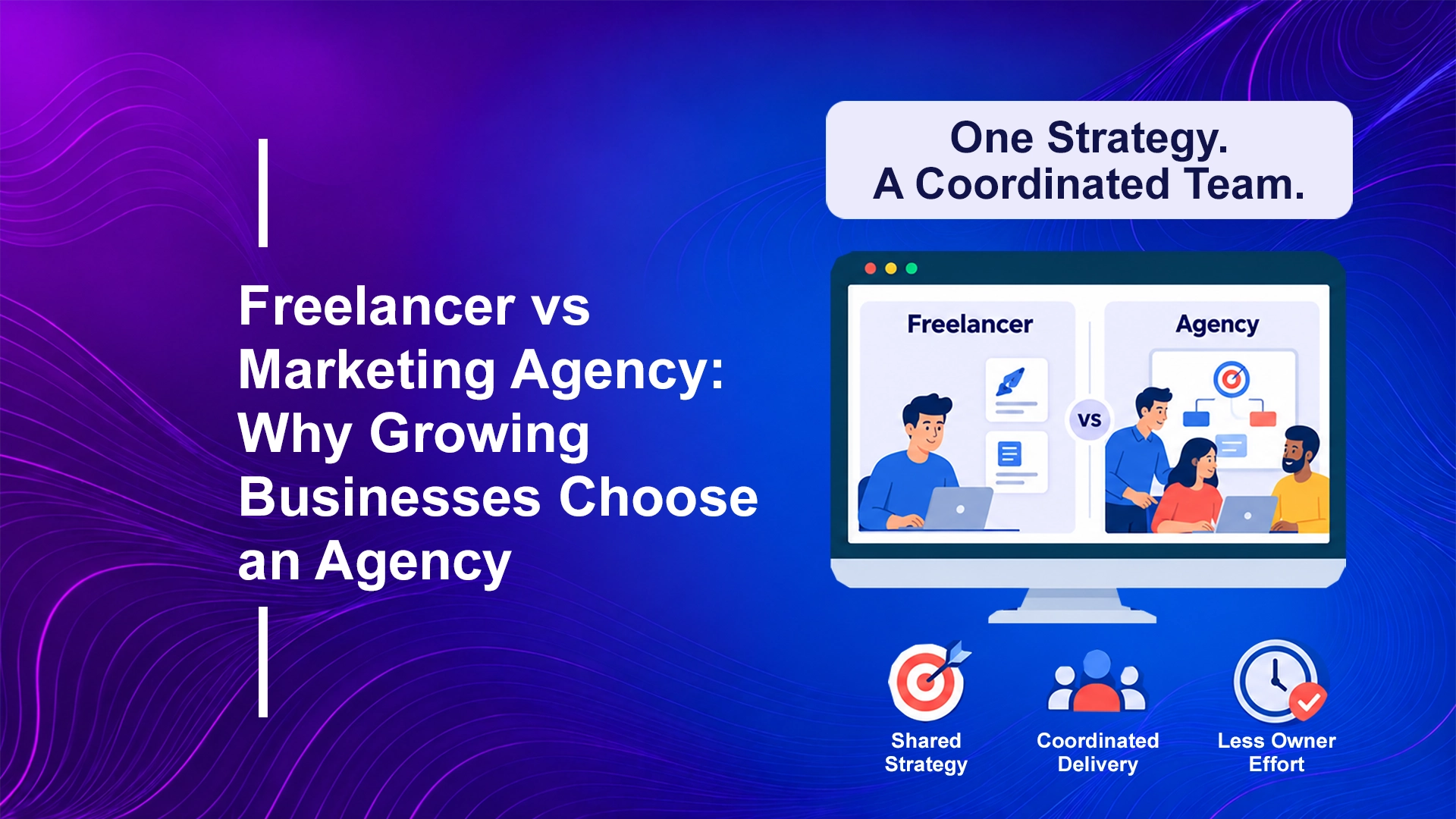
Freelancer vs Marketing Agency: Why Growing Businesses Choose an Agency
Hiring help should give you more time to run your business. When marketing starts requiring constant coordination, it may be time to rethink who is managing the bigger picture.
At 9:40 on a Thursday evening, Rohan was searching his laptop for the latest version of his company's logo.
His designer needed it for next week's posts. His developer had uploaded an older version to the website. Meanwhile, his freelance writer had sent an urgent message: "Are we speaking to early-stage founders or established businesses?"
He had answered that exact question before. Somewhere in another conversation.
Rohan is a fictional business owner, but his situation illustrates an important reality of the freelancer vs marketing agency decision: the work that remains on your desk after you hire someone.
Six months earlier, he had decided to take his consultancy's marketing more seriously. Referrals were bringing in business, but he wanted a steadier, more predictable flow of enquiries.
He hired a freelance designer, a writer, and a developer. Each came with glowing recommendations. Each had a clear assignment.
The arrangement looked sensible on paper. Then the assignments started overlapping.
When the Business Owner Becomes the Marketing Manager
The first few weeks went well. The website looked fresher. Social posts appeared regularly. New articles were ready to publish.
But each person needed constant direction.
The writer wanted to understand the core value proposition. The designer needed approved copy before laying out graphics. The developer needed someone to decide which service offerings deserved the most attention on the homepage.
That someone was Rohan.
Soon, he was reviewing captions between client meetings, forwarding feedback across separate Slack threads, and checking whether changes had actually made it onto the live website.
His freelancers were completing the work they had been hired to do. But coordinating the whole operation was still his responsibility.
This is an easy cost to overlook when comparing proposals. A fee tells you what you will pay a supplier. It rarely tells you how much of your own time the arrangement will demand.
For a company with an experienced in-house marketing manager, coordinating independent specialists can work well. But for a founder already responsible for sales, delivery, and daily operations, it quickly turns into another demanding full-time job.
Freelancer vs Marketing Agency: What Are You Actually Buying?
A freelancer typically offers individual expertise within an agreed scope of work. A marketing agency provides several complementary disciplines, along with the overarching planning and coordination needed to make them work together.
The distinction depends heavily on the provider:
- Some freelancers are seasoned strategists with trusted networks.
- Some agencies offer little more than a loose collection of deliverables.
The most useful comparison is therefore between the responsibilities each engagement actually covers:
1. A Defined Specialist Task
- Working with Freelancers: Direct access to a suitable expert.
- Working with an Agency: Available, although an agency engagement may be unnecessary if you only need a single isolated task completed.
2. Several Marketing Disciplines (Design, Dev, Copy, SEO)
- Working with Freelancers: Requires separate hires, distinct contracts, and shared briefing across multiple individuals.
- Working with an Agency: Brings all required specialists under one unified, synchronized plan.
3. Day-to-Day Coordination & Project Management
- Working with Freelancers: Almost always stays with your internal team or founder.
- Working with an Agency: Sits with an assigned project lead or account strategist.
4. Consistent Brand Messaging
- Working with Freelancers: Requires manual alignment and constant review across independent contributors.
- Working with an Agency: Managed through a shared overarching strategy and centralized editorial review.
5. Cross-Channel Performance Review
- Working with Freelancers: Tends to focus narrowly on each individual specialist's scope.
- Working with an Agency: Connects findings across search rankings, paid channels, email flows, and website analytics.
6. Continuity & Redundancy
- Working with Freelancers: Depends on individual availability, personal schedules, and ad-hoc backup arrangements.
- Working with an Agency: Provides team coverage, documented workflows, and seamless project handovers.
For a growing business, the agency advantage becomes far more significant as your marketing initiatives become interconnected.
Why a Marketing Agency Can Have the Upper Hand
1. A Shared Strategy Gives Every Piece of Work a Purpose
When Rohan reviewed his marketing efforts as a whole, he noticed something uncomfortable.
His social content addressed people starting their first business. His homepage described high-ticket advisory services for established companies. His blog articles covered broad business topics without giving readers any clear reason to enquire.
Each piece made sense in isolation. Together, they presented a fragmented, confusing picture of who the consultancy actually served.
A capable agency addresses that uncertainty before expanding the content calendar:
- Who is the priority customer?
- What specific problem brings them to the business?
- What proof makes the offer credible?
- What exact next step should they take?
The answers give writers, designers, developers, and channel specialists a common brief. They also make approvals effortless, because every creative decision is judged against an agreed commercial direction.
2. Specialists Can Solve Problems Together
Imagine that visitors are reaching your service page, but very few are submitting an enquiry.
The root cause could be weak targeting, unclear value copy, missing social proof, a confusing page layout, or a contact form that is frustrating to complete on mobile.
Producing more social posts or publishing more articles will not solve any of those issues.
One of the greatest practical benefits of hiring a marketing agency is having access to cross-functional specialists who can investigate different parts of the same customer journey. Within an agreed scope, they can diagnose the actual bottleneck, coordinate a multi-disciplinary fix, and review conversion metrics afterwards.
That saves the business owner from having to diagnose the technical issue before knowing which freelancer to call.
3. Accountability Becomes Easier to Define
Marketing gets difficult to manage when every progress update ends with a different explanation.
The content is published. The website is live. Traffic has increased. Yet the sales team is still asking where the qualified leads are.
An agency relationship creates a single, accountable venue for that conversation:
- What activities are attracting high-intent prospects?
- Where in the conversion funnel are enquiries dropping off?
- Which channels justify increased investment?
While no agency can guarantee closed sales, a good partner takes full responsibility for investigating performance, tracking conversions, and executing clear next steps.
4. Delivery Becomes Less Dependent on the Founder
As marketing expands, so does the volume of information people need to share.
A new service offering affects website copy, content topics, email follow-up sequences, and analytics tracking. Without a defined operational process, the founder becomes the bottleneck carrying updates back and forth between contributors.
A well-managed agency maintains shared briefs, review schedules, and structured project documentation. When someone takes time off, delivery continues uninterrupted.
A Practical Example from Onnea Labs' Work
In a recent engagement with a growth-stage B2B business, we found that their website, automated email nurture sequences, and conversion analytics were operating completely in silos.
Our engagement brought together:
- Sharper landing pages designed specifically around buyer intent and conversion hierarchy.
- Automated nurture sequences that continued the conversation established on the page.
- Clean conversion tracking that gave the leadership team visibility into which initiatives actually drove pipeline.
A landing page shapes a visitor's initial expectations. Follow-up communication needs to sustain that dialogue. And tracking needs to show what happened along the way.
When those decisions are planned and delivered together, the business has a clear, measurable foundation for sustainable growth.
Is a Freelancer Cheaper Than a Marketing Agency?
For a limited, one-off assignment, a freelancer almost always offers a lower upfront cost because you are purchasing a narrower scope of expertise.
For ongoing marketing, however, the real comparison requires a broader perspective.
Consider the combined fees of every specialist involved, the subscription cost of tools and software, the internal hours spent managing people, and the expensive cost of revisions when one person's deliverable conflicts with another's.
A practical way to compare proposals:
$$\text{Total Marketing Cost} = \text{Supplier Fees} + \text{Tools} + \text{Internal Management Time} + \text{Avoidable Rework}$$
An agency fee covers strategy, execution, and coordination across multiple disciplines. For Rohan, the issue became obvious when he reviewed his weekly calendar: marketing management had consumed the time he had intended to spend pitching new clients and serving existing ones.
When Should You Hire a Marketing Agency?
An agency becomes the superior choice when:
- Your marketing channels must work together: Your website, SEO, content, and conversion follow-up need to be synchronized.
- You lack internal management bandwidth: You do not have the time or expertise to project-manage multiple independent contractors.
- Activity isn't producing pipeline: Your marketing looks busy, but its actual contribution to qualified enquiries is unclear.
- You need brand consistency: You need unified messaging and positioning across every buyer touchpoint.
- Your business requires ongoing momentum: You need continuous strategic guidance, execution, and iterative optimization.
Conversely, a freelancer remains the ideal choice for a clearly scoped project, highly specific subject-matter advice, or extra execution capacity managed by an existing in-house marketing director.
How to Choose an Agency That Earns Its Fee
Before signing an agreement, ask the questions that matter:
- Who manages the strategy and who does the daily work? Understand the team structure and direct points of contact.
- How often are results reviewed? Confirm reporting cadences and what happens when performance falls short of targets.
- Who owns the assets? Ensure full, unrestricted ownership of your analytics, accounts, code, and creative assets.
- Pay attention to the questions they ask you: A trustworthy agency partner will seek to understand your customer journey, sales cycles, and operational capacity before recommending a scope of work.
Giving Your Business Room to Grow
When Rohan revisited his marketing strategy, his brief had evolved.
He still needed sharp copywriting, modern design, and clean web development. But more than anything, he needed a team that could coordinate those skills around clear business objectives.
He wanted to participate in high-level strategic decisions that drew on his industry expertise, while trusting an integrated team to execute delivery.
At Onnea Labs, our digital marketing and website services span SEO and AEO optimization, high-performance web development, automated workflows, and conversion analytics. Engagements can start with a targeted priority and expand as opportunities become clear.
If managing your marketing is taking more time and energy than running your business, we can help you diagnose where the bottlenecks are and build an engine that works.
Book an introductory call with Onnea Labs to discuss your growth roadmap.
Frequently Asked Questions
Is a marketing agency better than a freelancer for a small business?
An agency is usually a better fit when a business requires multiple disciplines (e.g. SEO, web development, content, and design) and lacks the internal bandwidth to manage them. A freelancer is ideal for standalone assignments or when you already have an in-house marketing manager to direct their work.
What are the main benefits of hiring a marketing agency?
The primary benefits include integrated strategic planning, cross-functional problem-solving, consistent brand messaging across channels, single-point accountability, and uninterrupted delivery without founder bottlenecks.
How should I compare agency vs freelancer costs?
Look beyond the invoice rate. Factor in the total cost of ownership: specialist hourly rates, SaaS subscriptions, the founder's time spent managing and briefing contractors, and the costs of rework when independent pieces don't align.
Can I start with one service instead of a full agency package?
Yes. Many businesses begin with an immediate priority—such as a website rebuild, an SEO audit, or conversion tracking setup—and expand into ongoing growth services as commercial results are proven.